The first Sonic game arrived in 1991. SEGA SAMMY places it in the history of Mega Drive: the 16-bit console launched in 1988, later became a hit in North America and Europe, and gave Sonic a stage as one of the characters most closely associated with Sega. Looking back, I find the relationship more interesting than the idea that a mascot simply helped sell a console. Sonic’s body, the level rhythm, and the platform’s brand identity share the same frame from the beginning.[segments-2014][integrated-2024]
Sonic broke through with speed. Why did speed never swallow the character?
A first encounter with Sonic makes speed easy to remember. The character rushes forward. The ground scrolls. Slopes, springs, and rings turn the screen into a route unfolding in front of the player. But speed is not simply a faster movement value. Players decide when to run with the terrain, when to brake, and when to risk a slope they cannot fully see. The level turns fast movement into choices, and choices make another run feel different. Speed is the surface. Reading the ground makes it controllable.
That is why Sonic does not need to sprint every second. If players hold one direction without looking, speed brings collisions and mistakes. If they read the route, slopes, springs, and loops connect into fluid movement. The design shifts between “the game is pushing me forward” and “I know how to use this path.” Many games use speed to create excitement today. Sonic’s early appeal feels more like learning: first the speed surprises you, then you learn to work with it.
Do you remember the fastest run, or the route that got you there?
Sonic’s routes are rarely just straight corridors. Height changes, branches, and loops let players find different rhythms. A failed jump becomes a reminder to start earlier next time. Rings are collectibles, but they also hint at how terrain can connect into a move. After one run, players know the images. After several, they know the ground and the choices. For a different approach to spatial learning, see how Metroid teaches players to remember a map.
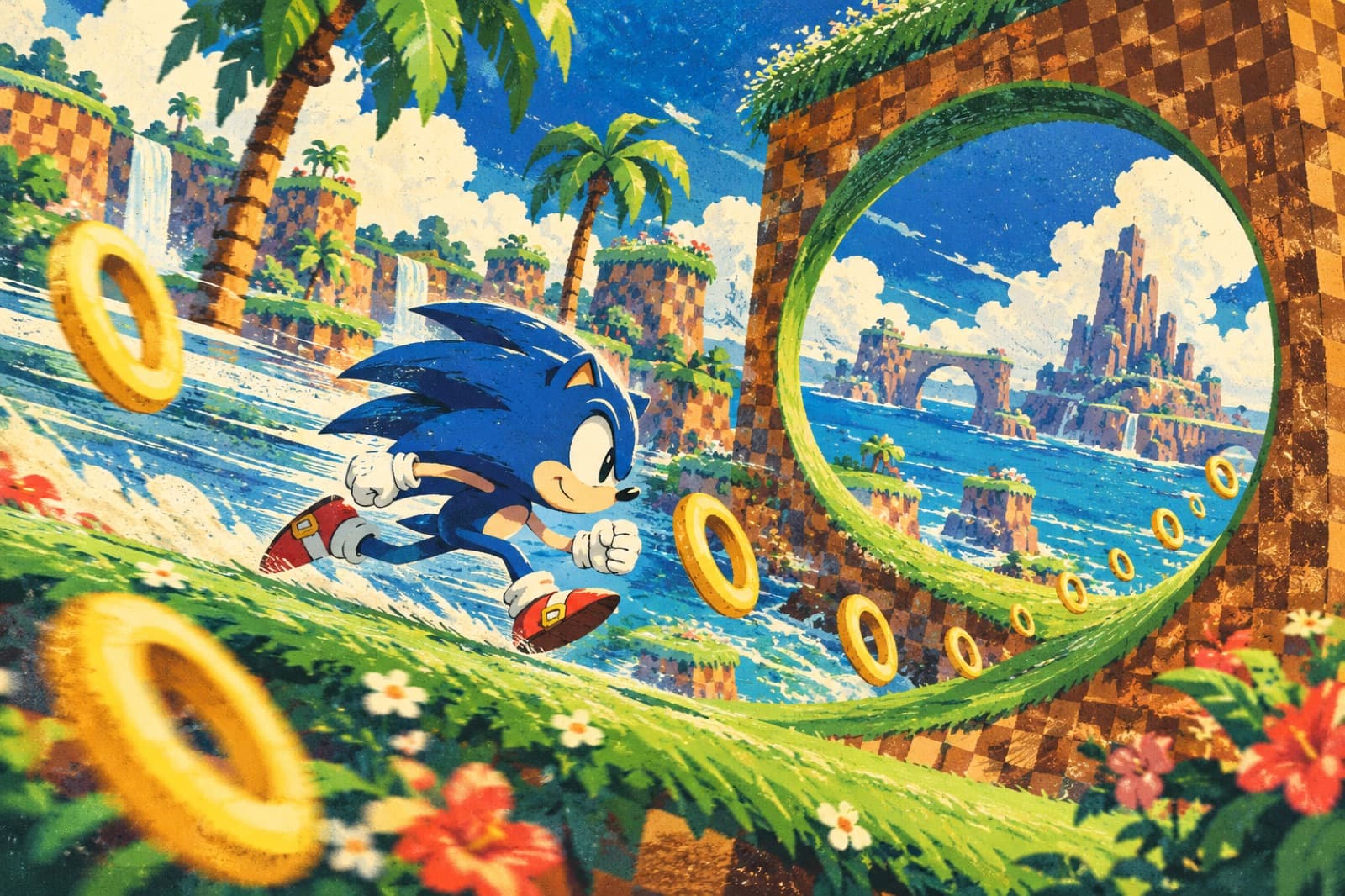
I love this way of making players remember a route with their bodies. The game does not explain the whole space like a map. It lets that space become familiar through repeated attempts. Players may not remember a coordinate. They remember “jump here” or “use that slope to gain speed.” That kind of memory feels a little like keeping time with music. You do not need to count every beat once you know the song. Sonic turns action-game routes into a rhythm that players complete for themselves.
Who gave the 16-bit console its personality?
SEGA SAMMY’s report says Mega Drive’s success overseas, together with globally recognized IP such as Sonic, became an important part of Sega’s brand. That does not mean Sonic alone determined the console’s market result. It does show that the character and platform developed a lasting relationship. Think of the blue hedgehog and you may recall the console’s colors, advertising, buttons, and speed. Think of Mega Drive and Sonic’s music and levels come to mind.[integrated-2024]
We often treat a mascot as part of a logo, but Sonic feels more like a character that can be reinterpreted. Later games adapted him to new platforms, cameras, and play styles. He also entered film, animation, and licensed media. Every change invites the same question: is this still Sonic? To me, that ongoing debate is exactly why he was not sealed inside 1991. Longtime players remember their first route. New players may first meet him through a film, a recent game, or a friend.
What does Sonic’s speed still say three decades later?
Modern screens can show more detail, and loading no longer resembles the wait around an old cartridge. Yet when we start an early Sonic game, the first thing to return may not be a specification. It is the movement: race down a slope, lose control, then find a smoother path. New machines grow more powerful, but players still respond to a good action and a well-shaped route. That continuity makes me feel both how quickly time moves and how much it leaves behind.
I do not want to treat Sonic as a monument to Sega’s golden age. The character is deeply tied to Mega Drive, but he also lives through later players replaying, remaking, and discovering him. The 1991 game left more than a blue character. It left a simple question: how can movement itself become fun? As long as new work keeps answering that question, Sonic will not belong only to the 16-bit era.
From today’s perspective, Sonic is part of Sega’s attempt to define itself in its hardware years and a small example of the industry’s shift toward long-lived IP. The hedgehog runs fast. What has travelled with him for decades is the feeling that, when we press start again, the next route might still surprise us.
At full speed, why can letting go be the real skill?
Sonic is easy to remember for speed, but if a game only asks players to keep moving forward, speed quickly becomes monotonous. A level has to create rhythm through acceleration, slopes, hazards, and route choices. Players should enjoy moving quickly, but they still need to read the terrain at the right moment. Speed is not a one-way reward. It is a resource to judge: a slope invites a confident run, while an enemy or a drop calls for control.
That is why “fast” does not mean “uncontrolled.” Much of the pleasure comes from finding a balance between expectation and surprise. Once players know a route, they can anticipate what comes next. On a first pass, a new elevation change or turn can disrupt their plan. The design lets players feel as if they are flying while still asking them to look, choose, and live with the result of an input. The blue hedgehog’s speed became a readable language of play, not just a blur on screen.
The character’s impatience and lightness live in the controls: players create them by choosing when to sprint and when to slow down. If movement remains enjoyable, Sonic keeps a recognizable core even as the visuals and stories change.
How can a mascot bridge a console and its players?
Mega Drive needed memorable games and a character who could express the platform’s personality at a glance. Sonic’s speed and posture offered a short introduction to the hardware and its games: this was a machine associated with action, rhythm, and an arcade feel. The character was not just cover decoration or a mark beside a product name. He turned abstract technical qualities into an experience players could feel without first reading a specification sheet.[integrated-2024]
This work is easy to underestimate. Technical language speaks to hardware; a character speaks to people. Effective brand design lets the two meet in the same game. Sonic made speed more than a line of advertising. It became a rhythm that players could produce, control, and try to improve. He also gave Sega a visual center that could travel between games and advertising. The character’s appearance would change, but the energy he first expressed for the platform remains one entry point into understanding him.