As of October 2026, Sega faces a content business that includes established IP, film and licensing revenue, free-to-play services, and full-game development. It is no longer a home-console manufacturer, and the group’s Entertainment Contents business reaches far beyond any single title. The public materials released in 2026 focus less on a grand new slogan than on restoring balance among revenue, profit, and development resources.[history][strategy-2026]
Before reading Sega’s results, ask what the numbers include
SEGA SAMMY’s Entertainment Contents is a group business category, not a single game or development team. To understand its performance, we need to know the scope of the content business and the market conditions when the figures were released. I read the strategy page as the company’s view at that time, and keep forecasts and plans clearly marked as things still to be checked. I discuss what players actually receive at the level of the games. This prevents one financial figure from writing a simple verdict for a whole company or one title.
Sales climbed as profit fell: what is the gap telling us?
SEGA SAMMY’s business-strategy page lists FY2026/3 Entertainment Contents net sales of ¥326.6 billion and operating income of ¥32.4 billion. The company says sales increased year on year while profit decreased. Its FY2027/3 forecast is ¥357.0 billion in net sales and ¥42.5 billion in operating income. These are reported figures and a future forecast. The forecast is not a result already achieved. The page also says full games, some new free-to-play titles, and Rovio were soft, while existing free-to-play titles, subscriptions, DLC, animation, and licensing performed more steadily.[strategy-2026]
The comparison below covers SEGA SAMMY’s Entertainment Contents segment. FY2027/3 is a company forecast, not a reported result.[strategy-2026]
| Period | Net sales | Operating income | How to read it |
|---|---|---|---|
| FY2026/3 actual | ¥326.6bn | ¥32.4bn | Sales rose year on year; operating income fell. |
| FY2027/3 forecast | ¥357.0bn | ¥42.5bn | Company forecast; not yet an actual result. |
“Entertainment Contents” should not be treated as one console game. It is a group business category that covers a wider range of content and activity than one game studio. Reading these figures, I see two things at once. Sega’s IP and existing services can continue to generate income, but new development, the mobile market, and profitability do not become easy just because the brand is well known. Business results reflect organizations, games, and markets working together. One hit title cannot explain the whole picture.
Did cancelling Super Game mean giving up or changing the bet?
The May 2026 results presentation says Sega decided to cancel its previously planned Super Game project and that the cancellation would not create additional costs. It also says more than 100 development staff from some free-to-play projects had already moved to full-game development. Sega planned to launch four full games based on mainstay IP in FY2027/3. We should distinguish an organizational decision already made from a plan for the next fiscal year. The cancellation happened; the four games remain a forecast that must be checked against future announcements.[results-2026][strategy-2026]
I do not think cancelling one large project proves that Sega has given up on innovation. It looks more like a public recalibration of investment. When some free-to-play projects did not meet expectations, management changed resource priorities while keeping legacy IP, new games, and global releases in view. We can debate whether the choice is right, but the company is no longer treating one “super project” as its only future. Progress in this industry is not just announcing a larger vision. It also means admitting when an assumption needs to change.
This decision belongs to a longer shift: Sega left console hardware and shifted to multi-platform publishing, then expanded into mobile games, film, and licensing. New media do not guarantee success; each turn needs a sustainable way to connect works with players. History offers context, not a verdict on projects in 2026.
From coin slots to phones and cinemas, what changed for players?
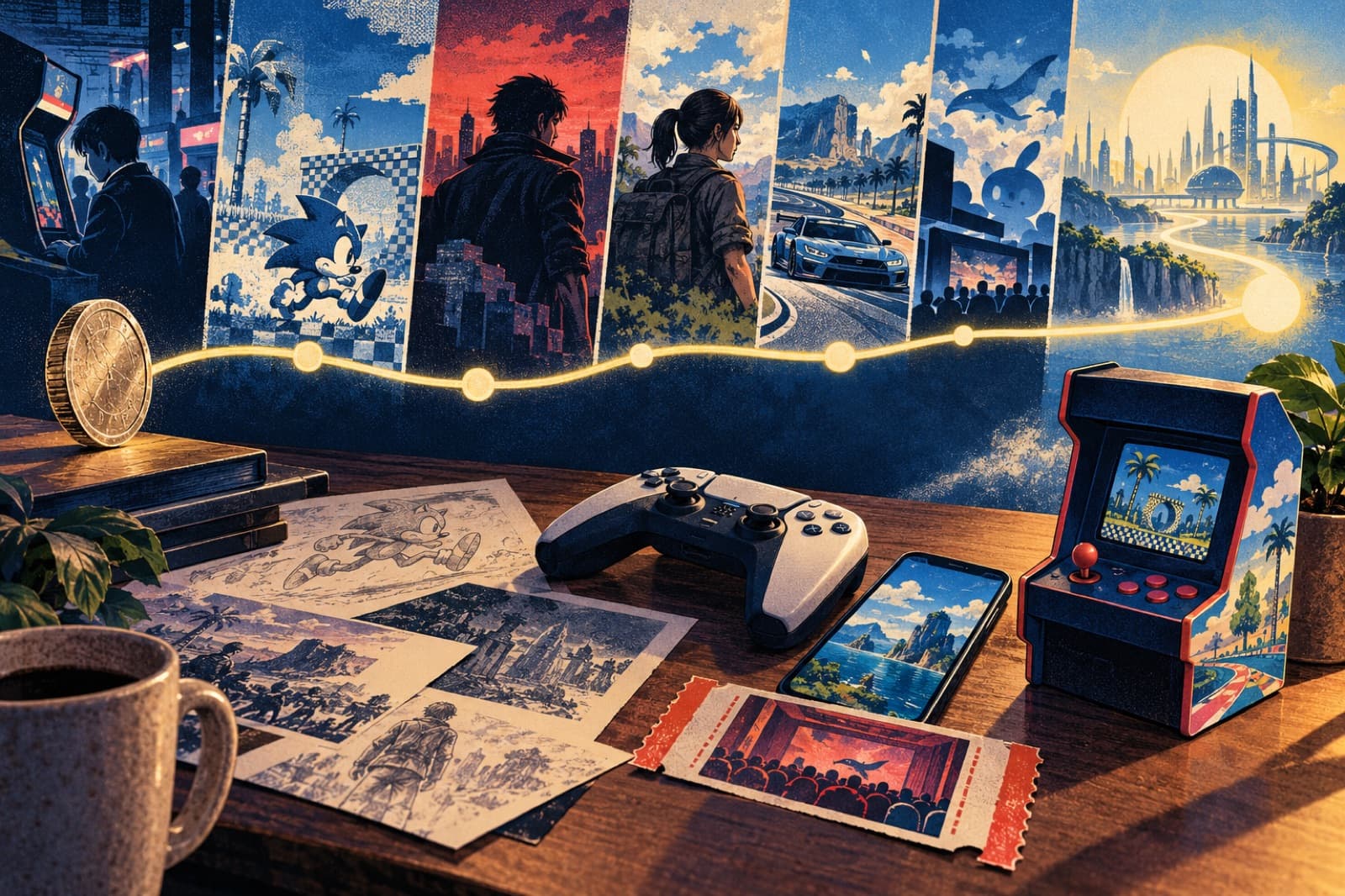
If we begin with the Service Games business roots, Sega has lived through more than seven decades of entertainment technology. Coin-operated machines, home cartridges, discs, dial-up networks, mobile apps, digital stores, and box-office releases have each changed how players meet a work. Technology makes screens sharper, networks faster, and distribution broader. Players still want characters, rules, and worlds that make them stay. We once walked into an arcade. Now we may meet the same story on a phone or at a cinema.
I like to marvel at progress, but I do not want to make history a straight line where later is always better. New platforms bring possibilities and also new failures, costs, and choices. Dreamcast’s online vision did not immediately become a stable commercial base for Sega. The company’s 2026 free-to-play strategy is still being adjusted. At the same time, old IP continues to find audiences through new games and media. Development does not always mean charging forward. Sometimes it means stopping, changing direction, and understanding what players need again.
In 2026, what makes Sega worth watching may be how it chooses between history and change. The company has names familiar to longtime players, and it must use new work and organizational skills to make those names matter to a new generation. To me, that is the most moving part of Sega’s history. Each generation once held its own future in its hands. The past we see today was once a tomorrow with no answer yet.
After the pivot, what should players watch next?
The cancellation of Super Game and the reassignment of some development staff to full games are clearly recorded in company materials. Their long-term effects cannot be judged on the day the decisions are announced. They need to pass through development, release, and player response before we can tell whether resources reached more suitable projects. Sega’s 2026 plans give us a window to watch. We still need to check whether games ship on schedule, how they perform, and whether investment between free-to-play and full games changes again.[results-2026][strategy-2026]
I think an evaluation should separate at least three layers: the problem the company wants to solve, the conditions teams actually receive, and the work players eventually get. Strategy materials and organizational changes can help us follow the first two. The last has to wait until the games exist. This is more accurate than treating a cancellation as automatic failure or a shift toward full games as automatic success. A company can change direction, but players’ trust still has to be built through its work.
This returns to a question Sega has faced throughout its history. A new medium can open a new entrance, but it does not automatically create stable creative work or business. Jukeboxes needed venues, consoles needed buyers, network services depended on infrastructure, and films or licensing required characters to stand on their own in different media; Sonic’s path across games and film offers a concrete example. In 2026, Sega still has to divide limited attention between familiar IP and new projects. History has not written the next step for the company. It only shows how it reached this point.
For readers, what deserves attention is not a verdict like “Sega is back” or “Sega is finished,” but the next public results and the work itself. Forecasts need to be tested against results. Strategy needs teams to deliver. Familiar IP needs new expression and audiences to build a relationship again. As someone who likes to marvel at how eras change, I want to keep watching with anticipation and room for judgment. The next chapter will be written by the games that follow.