Following Saturn’s 32-bit console chapter, Dreamcast launched in 1998. SEGA SAMMY’s corporate profile describes it as the first home video console with internet connectivity. That wording should be read as the company’s historical account, with the important point being that online access became part of the console’s design. In 2000, Sega launched Phantasy Star Online, a networked role-playing game for home consoles. In 2001, Sega withdrew from the home video-game platform business. In three years, Dreamcast moved from a promise of connection to the end of Sega’s hardware era.[about][segments-2014]
Was online play a selling point, or a new place to play?
Dreamcast put network access inside the central idea of a home console. Before this, relationships between console players mostly revolved around one television and one living room. A network began to let players meet across rooms and distances in a shared virtual world. Dial-up, waiting, and connecting feel slow now, but the change was substantial. A console no longer only read a game disc. It could also receive people and activity from beyond the screen.
The shift reminds me that technical leadership does not always become a user habit immediately. Connection speed, access costs, and household equipment all shape the experience. Today, we treat online functions as ordinary parts of a game device. It is hard to remember how unfamiliar it once felt to expect a distant player to appear on a home console. Dreamcast brought a possible future into the living room. Whether that future became routine depended on an entire infrastructure, not just the console.
How did Phantasy Star Online bring strangers into one world?
SEGA SAMMY’s timeline lists Phantasy Star Online, released in 2000, as the first networked role-playing game for a home video-game platform. It moved online connection from “the console can go online” to “players can play together.” Players could enter shared spaces, form groups, and learn from one another. Connectivity became part of the game’s structure rather than a hardware specification. Even when it took patience to connect, players could treat someone on the other end as a companion in an adventure.[segments-2014]
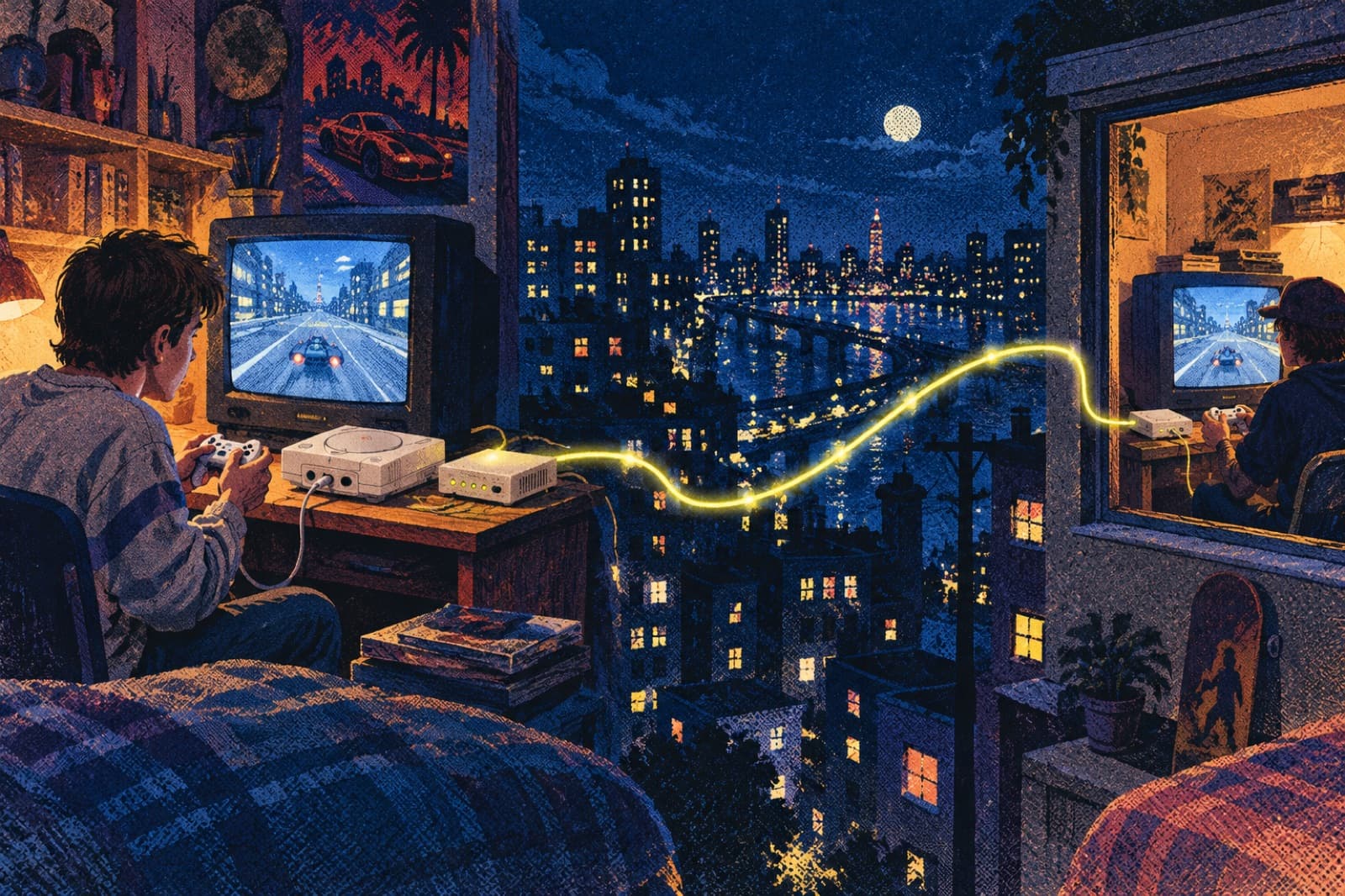
When we play online games today, we often notice login, matchmaking, or server status without considering how these systems were invented. Early networked games had to define what players could do, how they could communicate, and how they could make progress together. They also faced latency, disconnections, and hardware limits. I think the online experiments of the Dreamcast era matter not because every condition was mature, but because Sega turned the problem into play and learned what players wanted to connect for.
In 2001, did the hardware stop—or did Sega’s games?
In 2001, Sega withdrew from the home video-game platform business. SEGA SAMMY’s consumer-business timeline records the decision with that exact description. It did not mean Sega disappeared from video games. The company stopped competing with its own home console as a platform and began supplying games to other hardware. The hardware business left the stage, while game brands and creative teams continued.[segments-2014]
It is easy to compress this history into “Dreamcast failed,” but that phrase flattens business results, technical ideas, and players’ memories into one verdict. Leaving the hardware market was a major change in direction. It does not erase Dreamcast’s online experiments or make Sega’s later games less meaningful. I prefer to see 2001 as a translation of identity. Sega once delivered a game and a console together. Later it more often delivered games through someone else’s platform.
Why can an old console still feel like it came from the future?
Dreamcast did not predict every part of modern online gaming. It did not remove connection limits or make every online feature a lasting business model. What it made visible was a new relationship: a console could be a terminal into a shared space, and players could remain in one world after leaving the living room. Looking back, we can see that some ideas became normal while others disappeared as technology and business conditions changed.
I often think about how a period’s sense of the future becomes an ordinary feature later. Players once waited for a network handshake and listened to a dial-up connection. Now we may treat offline play as a choice. Meeting people across regions used to feel novel. Today friends around the world can meet online every week. Dreamcast did not win the console competition, but it made this transition visible. The year Sega left hardware, the relationship between players and games did not move backward.
Dreamcast felt futuristic because it brought online play into the living room early. Its exit also showed that a vision depended on networks, services, and viable business conditions.
Was a modem enough to make online play work?
It is easy to remember Dreamcast’s online vision as the simple idea that “a console could go online.” The actual experience depended on a whole set of conditions: access devices, network coverage, connection costs, servers, and the game itself all had to work together. If one link was unreliable, players might not reach the shared space as expected. A technical vision therefore met practical limits. When networking was not yet an everyday part of every household, online features could not be equally convenient for all players.
That makes Phantasy Star Online’s importance easier to see. It did more than prove a console could connect. It turned the question “what do we do after connecting?” into a design problem. Players needed reasons to wait, goals that required cooperation, and ways to live alongside strangers. A connection reduced distance, but it did not automatically create a community. Shared rules, communication, and a world worth entering still had to be built by developers. Online games have always been both technology and relationships.
I think today’s players can recognize a familiar tension in Dreamcast’s history. We want everyone to connect at any moment, and often forget that network capability depends on devices and services working together. Early waits, disconnects, and limits are not just jokes about the past. They remind us that every “instant connection” once required someone to make a difficult process work. Dreamcast does not represent the whole beginning of modern online games, but it made this transition visible on a home console.
What does the “last console” label hide about Dreamcast?
“ Sega’s last console” is a convenient way to recall Dreamcast, but it can let the ending overshadow the machine itself. It began as a product for players, with hardware design, a game lineup, networking experiments, and a release plan. Only later did it become a marker for Sega’s withdrawal from hardware. If we use its ending to explain every decision, it can seem as though the company was moving toward failure from the start. A steadier reading separates the choices made at the time, players’ conditions for using the system, and the change that came later.
This is not an attempt to excuse the commercial result. Sega eventually stopped operating its own home-console platform, and that changed the industry and the company’s future. But failure or withdrawal does not erase every value of a console. Players may remember Dreamcast for a game, an online feature, or a controller design. Historians can still ask which ideas later platforms adopted and which conditions had not yet matured.
“Last console” describes the end of a hardware path, not the value of the games. Dreamcast’s futurism and departure are two sides of a vision constrained by its time.