In 1993, Sega launched Virtua Fighter and described it in its annual report as the world’s first 3D computer-graphics fighting game. A year later, SEGA Saturn arrived as a 32-bit home platform. Together, these milestones show how Sega carried an arcade technology shift into the living room: players first encountered three-dimensional fighting in public venues, then saw a 32-bit console take on the imagination of a new generation. A few years later, Dreamcast brought online access into its home-console vision; see Dreamcast’s online experiment and hardware ending.[facts-2014][segments-2014]
How did arcades turn 3D from a spectacle into a feel?
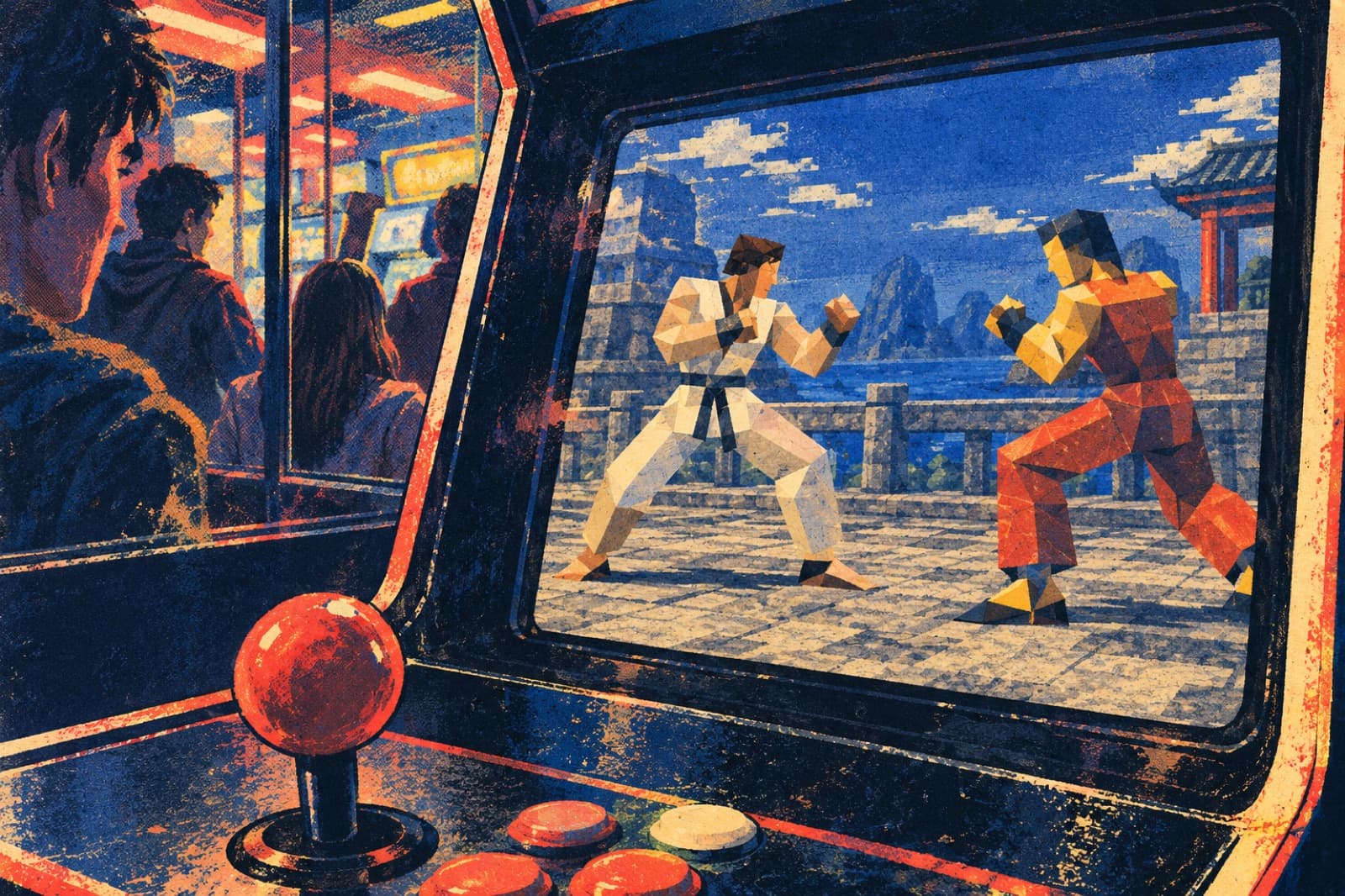
Before 3D fighting entered popular memory, three-dimensional graphics were often treated as a visual demonstration. Virtua Fighter mattered because it placed 3D space inside rules players had to understand. Position, attack distance, direction, and defensive timing were no longer only animations on a flat plane. Players had to watch an opponent approach, judge whether they could turn, and remember where a move would place their character. 3D did not simply add a dimension to the screen. It brought spatial judgment into play.
The shift was especially visible in an arcade. A player stood at the cabinet, moved a joystick or pressed a button, and watched a fighter move through a space with depth. A spectator could quickly understand the action without understanding every decision. To me, Virtua Fighter was a threshold. It moved 3D from a technical demonstration into a competitive set of rules players could practice, lose at, and study. Sega’s official material calls it the first 3D CG fighting game. What matters behind that distinction is how new space changed the feel of fighting.[facts-2014][integrated-2024]
Saturn brought the next generation home. Were players ready?
Released in 1994, Saturn pushed Sega’s home consoles into the 32-bit era. Players expected more from the next generation than three-dimensional images. They also wanted experiences at home that felt closer to the arcade. A console was not a smaller arcade cabinet. Its hardware had to work with a family television, a controller, and longer play sessions. Sega had to translate the movement and visual ideas tested in arcades into a platform and games suited to the living room.[segments-2014]
Looking back, I do not like the simple ladder of “2D is old, 3D is advanced.” Pixel art can have precise movement, dense color, and a strong rhythm. Three-dimensional space offers different views, distances, and freedom of movement. New technology changes what games can do, but it does not decide what makes them fun. The real challenge is finding a use for new capabilities without sacrificing clear inputs or responsive movement just to show off the hardware.
Why did better graphics still demand new design choices?
When 3D became a direction, developers gained more ways to express a game and more trade-offs to manage. Should the camera follow the character or watch the arena? From which angle should players judge distance? How should familiar fighting rules adapt to movement in depth? More processing power does not answer those questions. Virtua Fighter’s arcade value came from grounding a technology shift in readable actions and rules players could practice. Saturn expanded the question to an entire console: how could a home platform balance its arcade heritage, different kinds of games, and the expectations of a new generation?
Players may not remember a console’s hardware architecture. They do remember whether a character responded when they pressed attack, or whether a match made them want another round. Technology gains meaning when people use it. I think the 3D transition of the 1990s should not be written only as “who won the graphics war.” It was an industry learning a new grammar together. Characters could move into depth, cameras took on narrative work, and controls had to change. That learning included success and hesitation. Hesitation is part of the history too.
What kind of excitement was packed into those polygons?
Today, 3D feels ordinary. Game characters can be viewed from many directions, cameras can move through a scene, and actions can unfold along more routes. Around the Saturn era, three-dimensional space still felt new. It suggested that the screen was no longer only a flat stage. Characters seemed able to enter a world with real distance. The feeling did not have to come from realism. It could come from discovering that a game could turn this way for the first time.
I often think of technology history as a collection of firsts: the first time a fighter moved around an opponent, the first time a home console promised an arcade-like experience, the first time a player understood that a camera also had to be designed. Those firsts have become common sense, but they have not lost their value. Virtua Fighter and Saturn preserve a record of creators and players learning a new grammar together. Understanding that history can also help us avoid mistaking technical progress for a design answer.
Did 3D ask players to learn how to read space again?
Virtua Fighter appeared in arcades in 1993. SEGA SAMMY’s corporate timeline calls it the first arcade 3D CG fighting game. That description shows how the company understood its place in history. More importantly, the game placed fighters in a space with depth instead of keeping them only on a flat left-to-right plane. Players had to judge distance, direction, and timing differently.[segments-2014]
In a two-dimensional game, players often understand a character through a clear horizontal route. In three dimensions, camera and spatial awareness become part of the design. Turning, moving to the side, or creating distance from an opponent can change how a player reads the situation. New visual capability did not automatically provide new play. Teams had to translate spatial change into rules players could understand, learn, and repeat. Technology widens the choices; it does not make them for players.
Saturn launched in Japan in 1994, at a time when players were beginning to expect three-dimensional experiences. The console had to carry the excitement created by arcades while meeting the reality of more varied home-game genres and higher expectations. Today, early polygons may first look angular and limited. To creators at the time, however, each movable viewpoint meant reconsidering cameras, movement, and level structure. Those imperfect shapes preserve the industry’s trace of learning a new visual language.[facts-2014]
I see this period as a shared learning process rather than a technology contest with only winners. A new hardware generation is quickly replaced by a stronger one, but the ways players understand space and creators organize a camera remain in later games. Whenever a screen suddenly seems larger, people have been asking how to show players where they are and make movement matter.
Did 3D change how players understood failure?
Three-dimensional space offered more directions for action, and more ways to make a mistake. Players could misread distance or angle, or need to relearn when an action’s response differed from what they expected. That frustration did not always mean the design had failed. If feedback was clear, players could gradually turn unfamiliar controls into skill. Virtua Fighter placed fighting moves in a new space, while Saturn brought that change into the expectations around a home platform. Players and developers faced the same question: when the rules change, how does mastery begin again?
This is why early 3D is not best judged by polygon counts. Players need to read distance, see what the camera reveals, and get feedback they can learn from. Developers and players had to discover those rules together.