To date Sega’s beginnings accurately, it helps to separate two years that are often folded together. SEGA SAMMY’s annual report records 1951 as the company’s founding year, while 1960 marks the establishment of Nihon Goraku Bussan, the Japanese predecessor company. In 1965, that company merged with Rosen Enterprises and became SEGA Enterprises. Sega did not begin with a home console. It grew out of a coin-operated entertainment business built from services, machines, and venues.[annual-2009][integrated-2024]
Why did Sega’s first calling card play music?
Service Games (1951) and Nihon Goraku Bussan (1960) mark related but distinct points in Sega’s corporate history. Sega Sammy records both dates: one traces the business roots, while the other marks its Japanese predecessor. A company’s legal entities, operations, and brand name may begin at different times, so the dates should remain distinct.[annual-2009][integrated-2024]
The predecessor established in 1960 developed the SEGA 1000, a domestically produced jukebox. SEGA SAMMY’s integrated report explains the name as an abbreviation of Service Games and treats it as an early expression of the SEGA brand. That detail makes a fitting opening: four letters later associated with video games first appeared on a jukebox. People put a coin into a machine and received music in return. From the start, Sega’s business involved more than game content. It also involved bringing machines into public places, making them visible, and giving strangers a reason to stop.[integrated-2024]
How did a submarine game cross the ocean?
After the name changed in 1965, the company carried its brand into more kinds of amusement. Periscope, released in 1966, was a coin-operated game built around a submarine-style viewer. Players aimed through an optical device and pressed a button to fire. The rules look simple today, but the machine combined sight, controls, and posture into an experience that was easy to understand at a glance. Its popularity in Japan and overseas was an important step from operating amusement equipment toward manufacturing branded entertainment products.[integrated-2024]
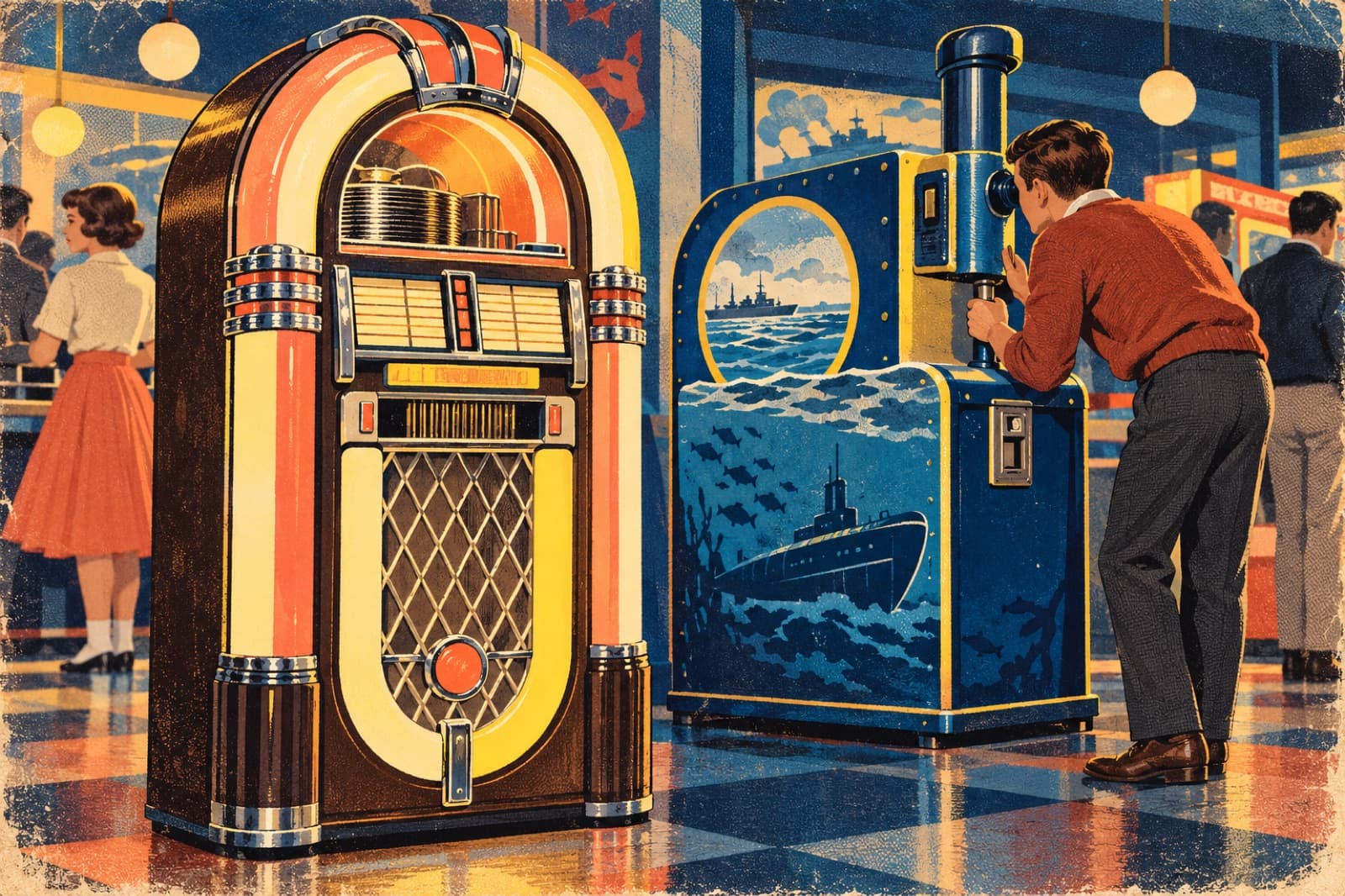
I like Periscope as a starting point because it reminds us that games do not always begin with a character on a screen. They can begin with a large machine, a queue, and a few minutes of friends watching from behind. Early arcade success belonged not only to code and graphics, but also to a cabinet’s size, sound, coin slot, and location. Players did not wait in a private room for content to appear. They entered a place that already had lights, noise, and an audience.[integrated-2024]
Can the machine itself become part of the game?
In the 1980s, Sega made the physical side of arcade play more prominent. SEGA SAMMY describes Hang-On, released in 1985, as the world’s first motion-controlled game cabinet. The same year brought UFO Catcher, which turned operating a mechanical claw into an entertainment loop of attempts and coins. Here, “motion” did not mean only the sensor technology associated with later games. It also meant climbing onto a motorcycle-shaped cabinet and leaning to steer, or moving a joystick while a player watched a claw descend.[integrated-2024][facts-2014]
Arcades were not merely a transition before consoles. They were a culture in their own right, shaped by queues, spectators, and shared turns; the last coin on the arcade floor captures that social side. A cabinet invited passersby to stop. A high-score table made a play session public. A spectator could become the next player. Looking back, I am less impressed by one advanced feature than by Sega’s early understanding that novelty could come from the relationship between a person and a machine. Home consoles later moved play into living rooms, but these ideas about controls, display, and shared attention did not disappear with arcades.
What changes when coin-op leaves the arcade?
By 1982, Sega’s story already included equipment manufacturing, amusement-center operations, international distribution, and motion-based interaction. Home consoles would become a new stage, but they did not erase decades of experience. Coin slots taught the company how a player started a session. Arcades taught it how to compete for attention. Motion cabinets showed that body movement could become input. When we later talk about SG-1000, Mega Drive, or Dreamcast, it is tempting to focus only on chips and sales. I also want to remember that these consoles came from an entertainment-machine company that had been practicing for a long time.
From today’s perspective, 1951, 1960, and 1965 feel like three different camera angles: commercial roots, a Japanese predecessor, and a brand name. Together they take us into a bright arcade and then point toward the television at home. Sega’s first chapter was not a sudden video-game revolution. It was the gradual work of putting machines in front of people and giving them a reason to spend a coin and a little more time.
How does one coin change the pace of a game?
An arcade game usually had to make sense within a limited play session and a coin. Whether players could understand the rules quickly and wanted to try again after failing affected the machine’s ability to hold their attention. Sound, lights, physical movement, and response time were not decoration. They were part of the design. Periscope enlarged aiming into a cabinet-sized experience. Hang-On made leaning part of control. UFO Catcher shaped waiting and trying into a rhythm. Coin-operated play made a player’s time visible, and every action took place in a public setting.
That commercial relationship carried tension. A short session had to be easy to understand, yet leave a reason to continue. A cabinet had to attract passersby, but appearance alone was not enough. This reveals an early design problem: how do you let a player feel in control within a few minutes while leaving them curious about doing better next time? It was not unique to Sega, but it was part of the company’s everyday environment.
I would not draw a straight line from coin-operated games to modern live-service games. The eras, devices, and business models are very different. But questions about how players begin, when they return, and how a machine earns attention in a public place have not disappeared. They have moved from coins and arcades to accounts, updates, and on-screen prompts. Older machines may not have left us answers. They left questions that each generation of designers still has to revisit.
Without the arcade floor, what remains of the arcade?
An arcade experience also depended on where a cabinet stood, whether people were nearby, and whether its controls were easy to understand at a glance. A player paused by the machine, noticed its shape, heard its sound, and then decided whether to spend a coin. The setting became the first layer of the game’s interface. A striking action could not attract people from across a room if they could not read it. A simple game could invite people in because its buttons, viewing window, and posture made the first attempt clear.
Seen within Sega’s history, this means the company’s early experience was not only about manufacturing machines. It was also about presenting entertainment to people. Consoles no longer needed a corner in an amusement venue, but a boot screen, controller layout, cover image, and storefront entry still do similar work. They ask people to pause, understand a game, and take the first step. The medium changed; the work of inviting players in remained.