The first Sonic game launched on Mega Drive in 1991. At first, players met the character through a controller: accelerate, turn, clear an obstacle, and find a route through the stage that felt familiar or daring. For a closer look at speed and route design, see Sonic’s 16-bit level design. More than three decades later, Sonic appears in films, animation, and licensed products. SEGA SAMMY’s corporate history records that three live-action and animated films had earned more than US$1 billion at the global box office by 2025. Sonic the Hedgehog 3 alone earned more than US$490 million worldwide. These are film box-office figures, not game sales or company profit. They show that a game character has crossed the screen into settings with very different audiences.[integrated-2024][history]
Why does Sonic need to leave the game?
A game character has a direct relationship with the player. The player presses a button, and the character responds. A film does not offer that interaction, and animation does not ask viewers to control the action. When the medium changes, the character needs new ways to stay compelling. A game can make speed part of control and route choice. A film can use camera, editing, and sound to express it. Animation can shape personality through movement and expression. The same character appears, but the experience should not simply repeat itself.
That is what makes cross-media work interesting and easy to get wrong. If a work only presents a familiar name, color, and logo, it may be recognizable without helping an audience understand the character. If it finds what each medium can express, the familiar figure gains new room. For a game adaptation, the challenge is not to copy a stage onto a screen. It is to translate the feeling players enjoy into a story without interaction. Translation requires choices, and it can reveal something new.
After a strong box office, what do we still not know?
More than US$1 billion in box office across three films is a film-market result reported by the company. The figure shows that Sonic reached many moviegoers and gives us a way to discuss the commercial range of game IP. It does not prove that every viewer became a player, nor does it represent the full quality of every adaptation. Beyond box office, we can ask whether viewers want to know the character, whether the films feel familiar to longtime fans while remaining accessible to new audiences, and whether that interest later returns to games, animation, or other works.[history]
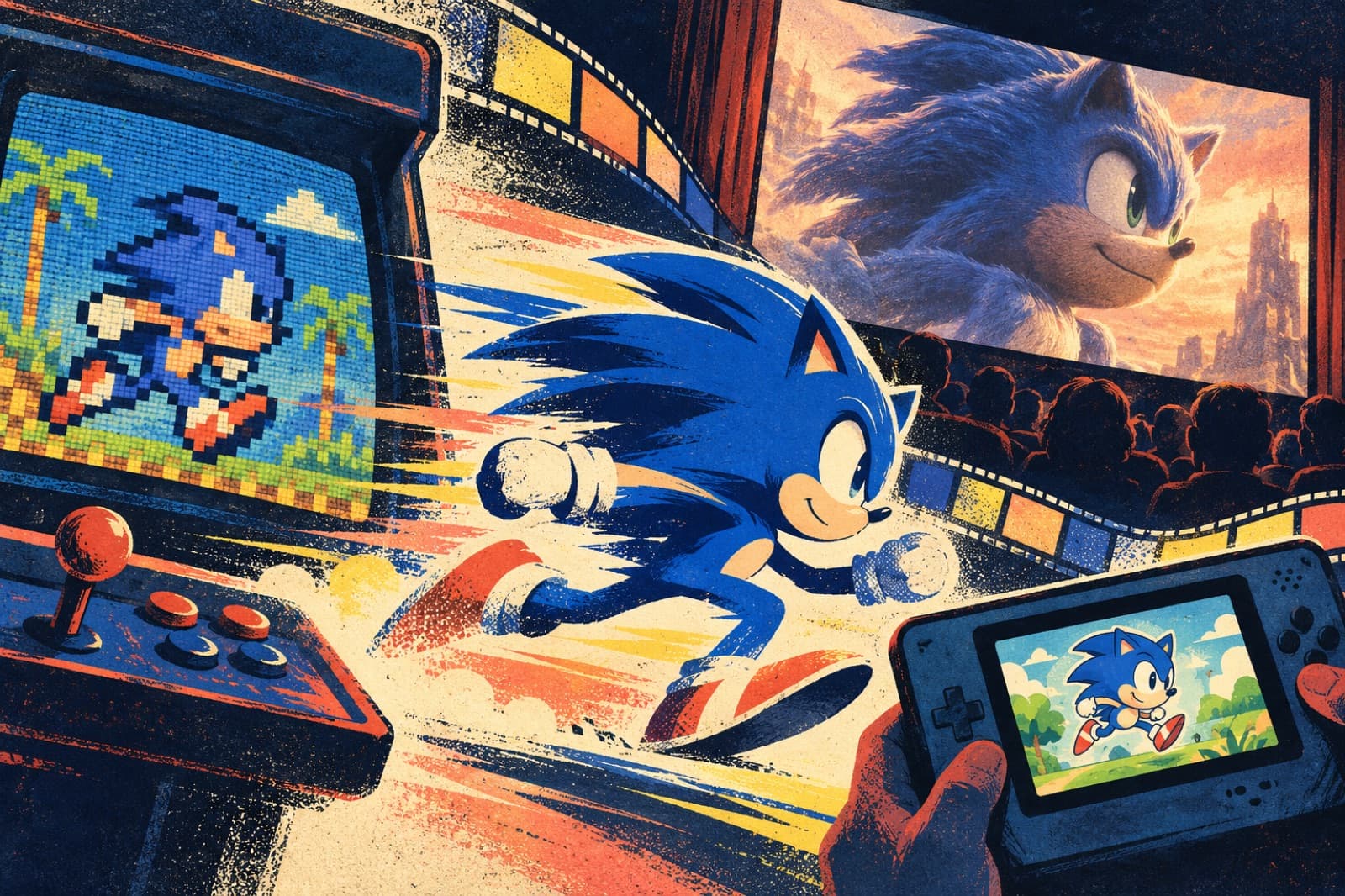
I like to separate the different meanings of “success” here. For the company, a film brings box-office and licensing opportunities. For creators, it is an exercise in translating game mechanics into visual language. For players, it may be an entrance they can share with family or friends. Different people take different things from the same work. Keeping these layers distinct means we do not have to use one number to decide whether a character is still alive.
A new audience meets Sonic. What might they do next?
In the past, someone discovering Sonic might first pick up a console or a game. Today, some people see him first on a poster, in a trailer, an animation clip, or on a licensed product. Whether they move on to a game depends on whether that game offers an experience worth staying for. More media doors increase a character’s visibility, but they do not finish the design of every work. The more doors there are, the more each work needs to explain what it offers: speed players can control, an adventure on film, or another way to spend time with the character.
This path can also change how families and generations meet. An adult may recognize Sonic from early games, while a child may know him first from a film or a short clip. They can then talk about the same character while carrying different memories. We do not need to assume every viewer will follow the same path back to a game. Cross-media work creates more chances to meet; each work still needs to welcome the person who arrives.
When Sonic crosses media, how much should change?
Appearing in more media creates pressure to keep updating a character. Each generation may want to preserve familiar qualities and also expect new stories, humor, and visual expression. Creators must decide how to balance recognizability with change. If too little changes, the character can feel preserved behind glass. If too much changes, the qualities that make the character recognizable may disappear. There is no fixed formula. Each work has to interpret the character, and each audience has to decide whether it accepts that interpretation.
From Mega Drive to the cinema, Sonic’s speed has been translated in different ways. The game gives speed to the player’s control. The film gives it to camera and editing. A licensed product compresses the blue hedgehog into a shape people recognize at a glance. Each form has limits and strengths. I do not think any one medium can replace another. That is why the character can be retold, and why an adaptation can sometimes lose the quality that mattered most.
How can a film bring a character back to the player’s hands?
The best cross-media relationship is not a funnel that only expands advertising. A film can introduce a character. A game can let people experience the character’s movement and rules themselves. Animation and other works can explore different story spaces. These works can guide audiences to one another while still standing on their own. Players should not have to watch a film before they can play. Viewers should not need to have played a game to understand a film. Each entrance should welcome someone arriving for the first time.
A character can now move between cinemas, handhelds, living rooms, and phones, which gives creators more responsibility as well as more reach. Film expresses speed through the camera; games return it to the player. Visibility may grow, but each work still has to hold an audience on its own.
How do you honor a decades-old character without freezing it?
A character’s presence over decades comes not only from company decisions, but from players and viewers interpreting it again. Some people remember game routes and movement. Others know the relationships in a film, or first recognize the blue figure through toys, clothing, or animation. These memories do not need to compete over who knows the “real” Sonic. Together, they show that the character has entered a cultural space larger than one work.
Longevity can also become a burden. If every new work only tries to remind everyone of the past, the character loses the ability to meet new audiences. If every appearance rushes to change, people who know the character may feel left out. Creative teams need to decide which qualities are central and which belong to a particular era’s expression. Market research cannot fully replace that judgment. It has to be adjusted through story, play, and audience response.
I care most about whether a character can respect old memories and still change. As media multiply, every work should not have to tell the same story. New audiences need a clear entry, while familiar characters need room to grow through new stories and play.