In 1983, Sega launched SG-1000, an 8-bit home video-game platform. For the first time, the company’s entertainment experience entered the home through a console. Players no longer had to visit an arcade to play on a television. In 1988, Mega Drive arrived in Japan as a 16-bit home platform, turning Sega’s console experiment into a longer competition for the next generation.[facts-2014][segments-2014]
Was bringing games home really just a matter of moving a machine?
Arcade play had a clear rhythm: insert a coin, start, finish, and make room for the next player. A home console changed that rhythm. The television and controller stayed in the house, so a session could stretch across an afternoon or restart immediately after a mistake. SG-1000 mattered not only as an 8-bit machine, but because Sega began testing a longer relationship between players and games. A console served more than one short purchase. It became an entertainment device that a household could return to.[facts-2014]
If we treat this period only as the beginning of a hardware specification race, we miss the change in space. Games entered the living room. Players chose when to start and stop, who sat in front of the television, and who watched nearby. The public high-score table of an arcade became private practice, or a challenge passed between siblings. My impression is that platform changes rearrange relationships between players. The chip is only one part of that story.
How did Mega Drive turn 16-bit into a promise?
Five years later, Mega Drive launched. SEGA SAMMY’s timeline lists it as a 16-bit home video-game platform released in 1988. The group’s integrated report says it later became a major hit in North America and Europe and provided a stage for Sonic, a character closely associated with Sega.[facts-2014][integrated-2024]
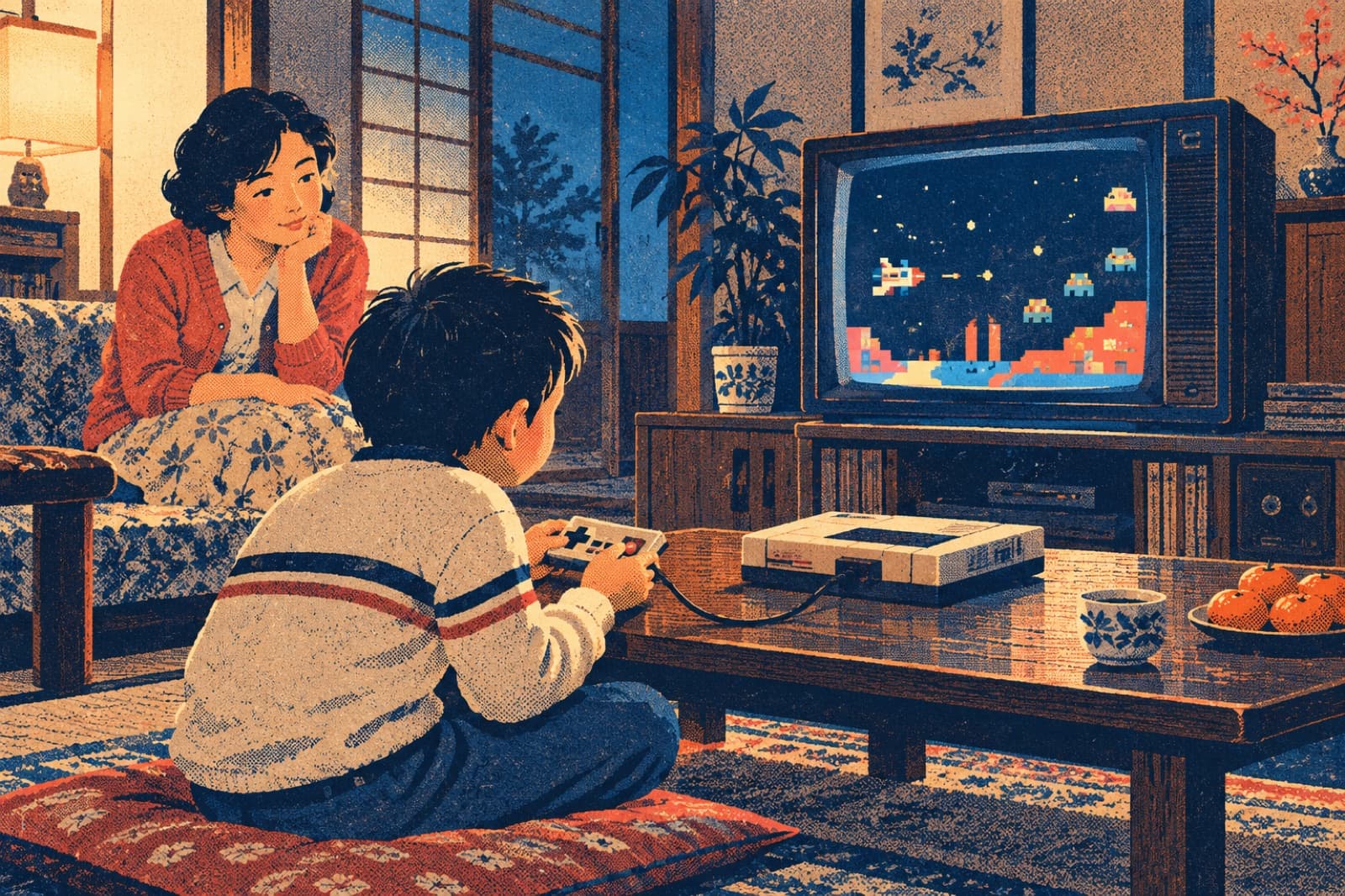
“16-bit” is a history label now. At the time, it promised a future with more colors, more complex images, and speed and sound closer to the arcade. Sega had spent years learning how movement, audio, and cabinets could attract players. It now brought those lessons into home consoles. Mega Drive did not simply copy an arcade cabinet into the living room. It gave a household device a strong tempo and a recognizable identity. It was a new expression for a company moving from public amusement machines to home platforms. For another 16-bit visual approach, see how the SNES used color and layers.
Why did console generations compete on more than hardware?
Console competition is often described as a contest over hardware specifications, but players usually remember how a machine felt. Its shape, controller, startup screen, games, and advertising turn specifications into identity. During the 16-bit generation, Sega began to distinguish itself with a sharper rhythm and attitude. Sonic became one of Sega’s clearest symbols in part through his speed-driven level design. This was more than a technology race. Sega wanted players to recognize a character: speed, action, arcade energy, and the confidence to compete for attention.[integrated-2024]
Seen together, SG-1000 and Mega Drive form a gradual path. The first console brought Sega into the home. The later platform gave it room to shape a recognizable presence there. The first answered, “Can we bring games home?” The second began to answer, “What should Sega feel like at home?” Brand histories often give the brightest space to moments of victory. I find the early experiments more revealing. A company places a machine in front of players, then learns from the experiences that make them stay.
How did the television become a new kind of arcade?
Technology history is often told as a move from fewer bits to more bits, from simple images to complex ones. For players, the change was more specific. A visit to an arcade became less necessary. A new input appeared on the family television. Game time became part of domestic routine. The five years between SG-1000 and Mega Drive show that setting taking shape. By the 16-bit era, Sega had a fuller hardware stage. Its next challenge was to create characters and games that players could recognize immediately.
I see those five years as two steps: SG-1000 gave Sega a place in the home; Mega Drive began to give the platform a distinct voice. The shift was about winning space in family life as much as upgrading hardware.
When games entered the living room, did the player relationship change?
When a machine belonged to a household, play was no longer divided into sessions by a single coin in the way it was at an arcade. Players could retry within the same game or leave a machine at home and return another evening. Owning a console became a new entertainment habit. A game was no longer a machine encountered while out; it was an entrance that could be opened repeatedly inside the home. For a company, competition extended beyond a few minutes at a cabinet. It needed a continuing set of works and experiences that made players want to stay.
This did not mean home gaming immediately replaced arcades. The settings offered different attractions. Arcades brought control and spectatorship together. Home consoles gave players more control over their time. When Sega brought arcade experience into the home, it had to rethink what suited individual play and what needed to be translated from the energy of a public venue. The SG-1000 was an entry into this space in 1983. Mega Drive made Sega’s home-platform identity clearer in 1988.
What I find most worth noticing is that hardware changed who arranged game time. Players once followed venue hours, queues, and coins. Home consoles returned the decision to start or stop to the player. We now take it for granted that a game can be started at any time, but that was once a new arrangement of daily life. A hardware generation brought more than richer pixels. It changed how people lived with games.
How long can one console stay in a player’s memories?
A home console placed a library of works in the same household, so players could compare games and build memories across them. A controller became a familiar object, a console’s startup sound joined daily life, and a game did not have to establish a relationship from scratch each time. Arcade memories often attached to one challenge and one venue. Home-console memories could attach to a room, friends, and family habits.
This does not mean every player collected consoles or every household treated games as a major activity. The point is that the platform changed how often and in what ways people encountered games. Once a console stayed by the television, games had a chance to enter recurring scenes of everyday life. Mega Drive later succeeded in North America and Europe, showing that Sega’s home platform was no longer only an experiment for Japan. It reached a broader player base.[integrated-2024]
Looking back, hardware specifications can tell us what a console could display, but they rarely explain why players remember it. Those memories often come from repeated use: taking turns with family, retrying the same stage, or seeing another machine at a friend’s home. A platform became an object in daily life. Sega’s move from arcades to homes did not simply shrink the screen. It began to take part in players’ longer routines.