In 2001, Sega left the home video-game platform business and shifted toward making and publishing games for other platforms. For players, the change did not have to appear in a single moment. Familiar brands continued to show up, but on consoles, computers, and later mobile devices made by other companies. For Sega, revenue, development plans, and hardware partnerships all had to be rearranged. In October 2004, Sega and Sammy integrated their management and established SEGA SAMMY HOLDINGS, moving Sega’s transformation into a new group structure.[segments-2014][history]
After hardware, how could Sega stay close to players?
A console manufacturer and a multi-platform publisher have different identities in a player’s mind. The first designs a device, operating system, and game lineup together. The second must make and maintain content across different platform conditions. After leaving hardware, Sega no longer decided which console a player bought, but it could bring games to more platforms. Development teams also faced new questions: how could a game keep its identity across devices and audiences, and how could an IP last longer?
I think this is one of the easiest turning points in Sega’s history to summarize and one of the most important to examine. After Dreamcast ended, players still saw the SEGA mark, and game development continued. But the logo had once been on a console’s case. Later, it appeared more often in a game’s opening or publishing information. The brand shifted from “which machine do I play?” to “which platform lets me play this company’s game?” The distance between players and the brand changed with it.
What new identity did Sega gain in the 2004 group structure?
In October 2004, Sega and Sammy established SEGA SAMMY HOLDINGS through a management integration. The companies brought different strengths. Sega was known for games and entertainment content, while Sammy was strongly associated with pachislot and pachinko machines. The group structure expanded the business and made it useful to distinguish two levels: SEGA as a game brand and related companies, and SEGA SAMMY as a holding company with multiple business segments.[history][about]
This distinction matters when writing about Sega today. When we discuss “Sega’s 2026 performance,” we may mean SEGA SAMMY as a group or its Entertainment Contents business, not an individual game studio. Different businesses contribute different revenue, investments, and risks. Players mainly see content, publishing, and IP. Explaining the company structure is not about adding jargon. It keeps us from attributing a whole group’s results to one game.
Without a console behind it, how could a new series speak?
In 2005, Sega released the first Ryu ga Gotoku game. The company’s official timeline places it among the development of its home game series. Its arrival showed that Sega could create a new series through a different genre and local cultural setting after leaving hardware manufacturing. In 2012, the group established SEGA Networks and expanded its networked and digital game business. These directions echoed some of Dreamcast’s online experiments, but in a new commercial environment and on new devices.[segments-2014]
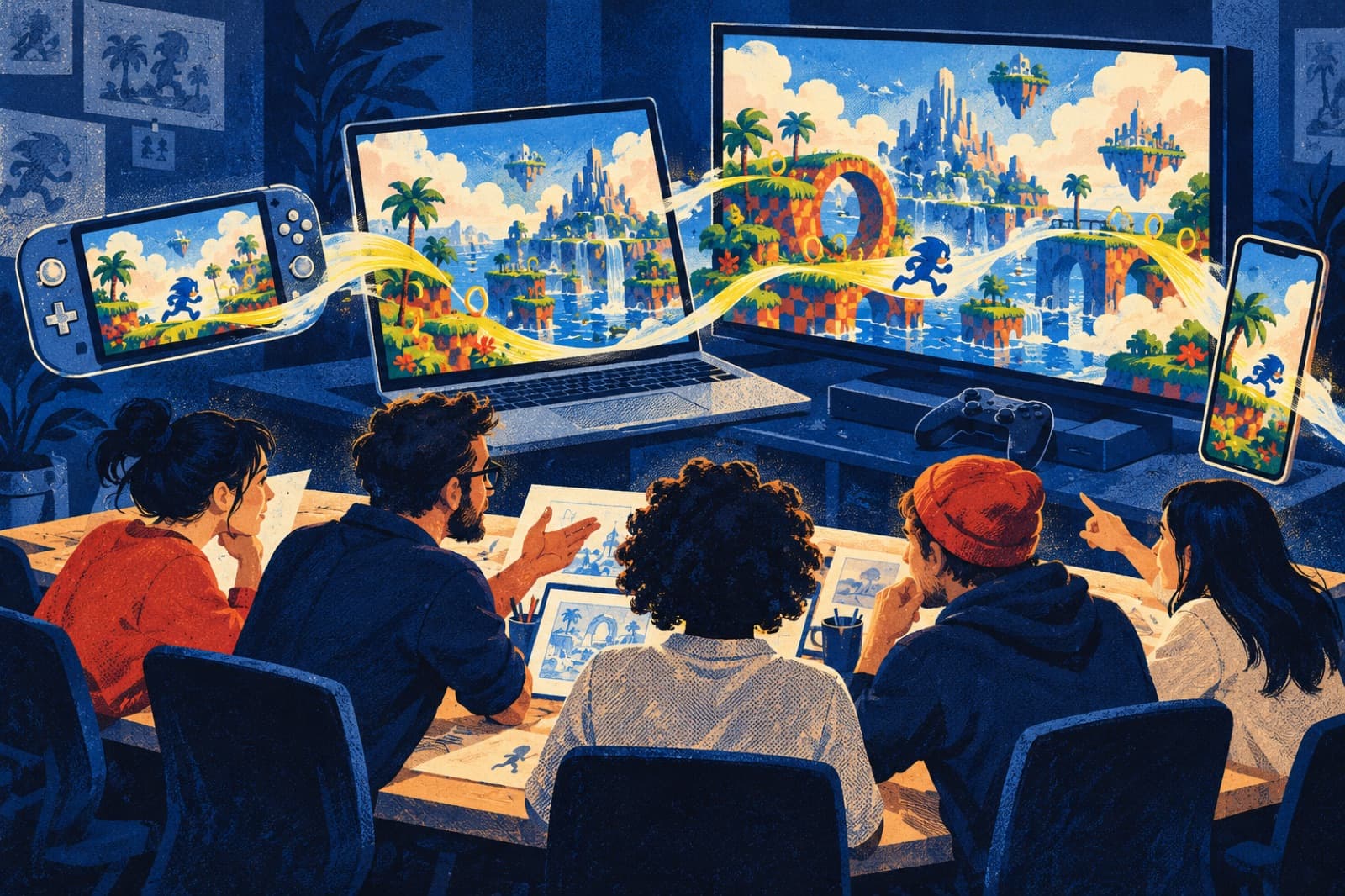
To me, the key was not that “Sega became a different company.” It was that the company began delivering games through different channels. Role-playing, action, simulation, and network services could appear on more devices. Game structures also began to stretch into updates, events, and communities. Sega no longer owned the stage through a console. Its content could continue to grow across platforms. In the past, a console generation ending could feel like a break in the whole brand story. Now a series could appear on different systems, turning a break into a migration.
What does a publisher gain—and what must it give up?
Multi-platform publishing does not remove constraints. Each platform has different users, technical rules, storefronts, and development costs. A company cannot design only for one piece of hardware. It must decide which series deserve long-term investment, which new projects are worth the cost, and how to coordinate global releases with local markets. Sega in its hardware era could bind an experience to its own machine. Sega as a multi-platform publisher had to explain why players should choose its game on the device they already owned.
A console once served as the company’s invitation to players. Today, games arrive through storefronts, subscriptions, or friends. Entry points are scattered and publishing is more complex, but content can reach more people. Sega has to find new ways to meet players within those rules.
What gets harder when one hardware line becomes many content lines?
Between 2001 and 2012, Sega moved from platform manufacturing toward supplying content and expanded its digital-game business within the group. We should not treat those years as an empty stretch after Dreamcast. New series, teams, and publishing methods appeared during that period. They did not replace players’ affection for old hardware, but they gave Sega routes that did not depend on console sales.
Looking back, I see 2001 as a rewrite of one sentence. Sega once said, “Here are our console and our games.” Later it said, “Here are our games; continue on the platform you choose.” The second sentence has less of the completeness of a hardware era, but more doors to players. As devices multiply, brands have to learn to be recognized across more entry points. The group’s later expansion through Atlus and Rovio is the next chapter in that content strategy.
When games stop belonging to one console, does collaboration change too?
After leaving its own hardware behind, Sega no longer decided that a game would serve a console it made itself. It had to work with other platform makers, storefronts, and player communities. Multi-platform publishing could bring content to people who already owned a device, but it also meant teams had to handle different performance conditions, controls, and release schedules. A game needed to preserve its core experience across platforms while meeting each one’s technical and commercial rules. That brought new freedom and new coordination costs.
For players, the change could look quiet. When buying a game, they no longer had to consider only a Sega console. They could look at the devices they already owned, where their friends played, and which store was convenient. For the company, the brand shifted from a hardware entrance to a content entrance. A console once combined a series, a controller, and a system menu into one experience. Later, Sega relied more on characters, play, and release rhythm to be recognized. Hardware was no longer the only medium between the brand and its players.
Between 2001 and the establishment of SEGA Networks in 2012, this route gradually extended from individual releases to networked and digital business. It should not be told as a transformation completed overnight. Teams had to learn new partnerships, publishing had to adjust to multiple platforms, and players had to find familiar Sega games on devices made by others. Historical turning points rarely have a clean dividing line. They become real through a series of new kinds of work.