Super Nintendo images have a soft density: bright without feeling sharp, detailed while leaving room to breathe. That look came from more than pixel counts. Layers, palettes, and displays all played a part. For another home-console path from the same era, see how SG-1000 and Mega Drive brought Sega into the home.
How can a few layers of pixels make a scene feel deep?
A background could drift slowly, a foreground could race past, and the character stayed steady in the middle. Parallax made flat planes feel distant. Transparency, rotation, and scaling gave even a still image room to breathe.
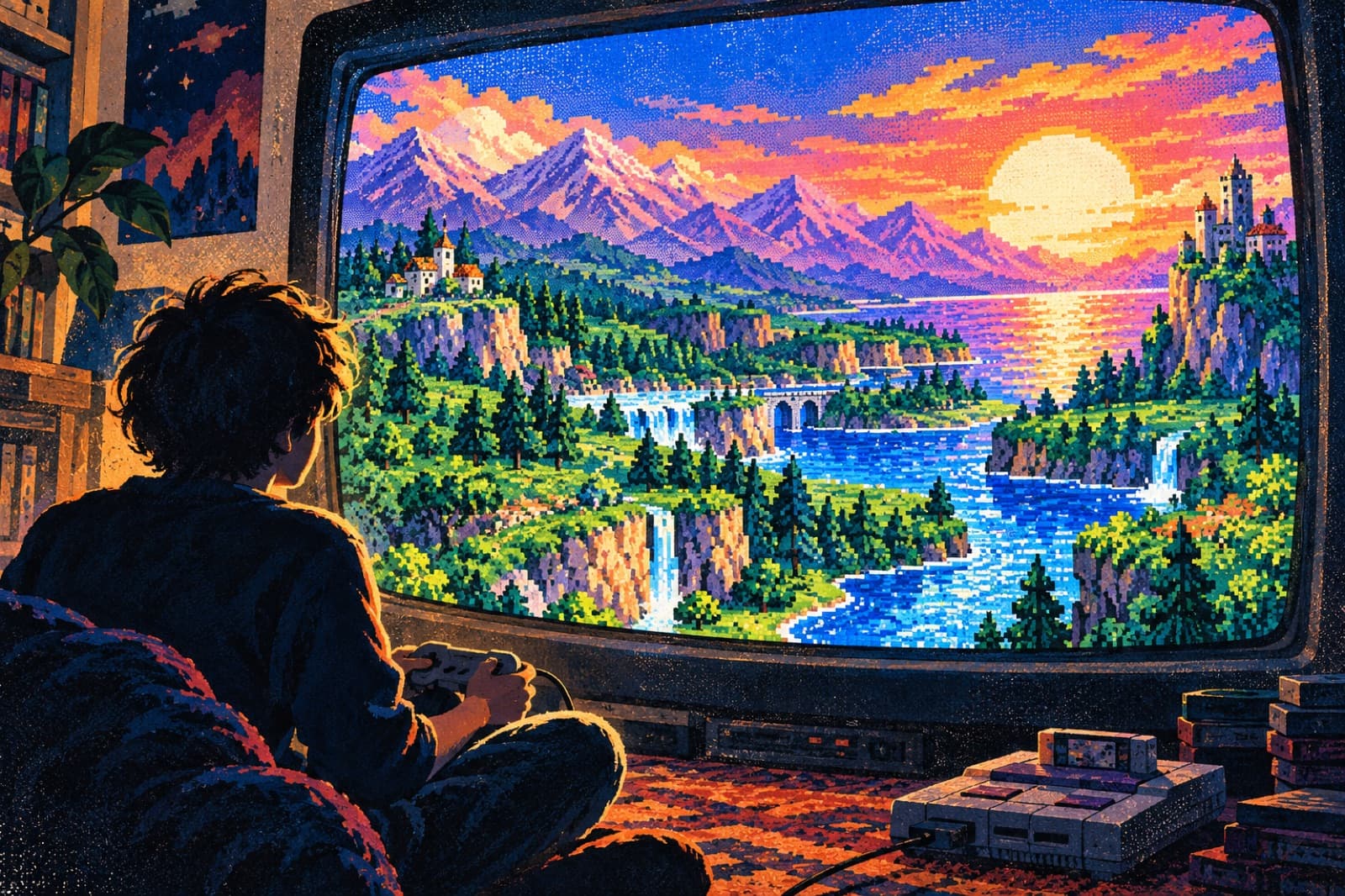
How did the old television become part of the color palette?
A CRT softened pixel edges and blended neighboring colors. Developers were not designing for razor-sharp squares, but for a glowing, slightly wavering pane of glass. Some of the dreamlike color was completed there.
The nostalgia filter was not added later. Sometimes it was the television in the living room.